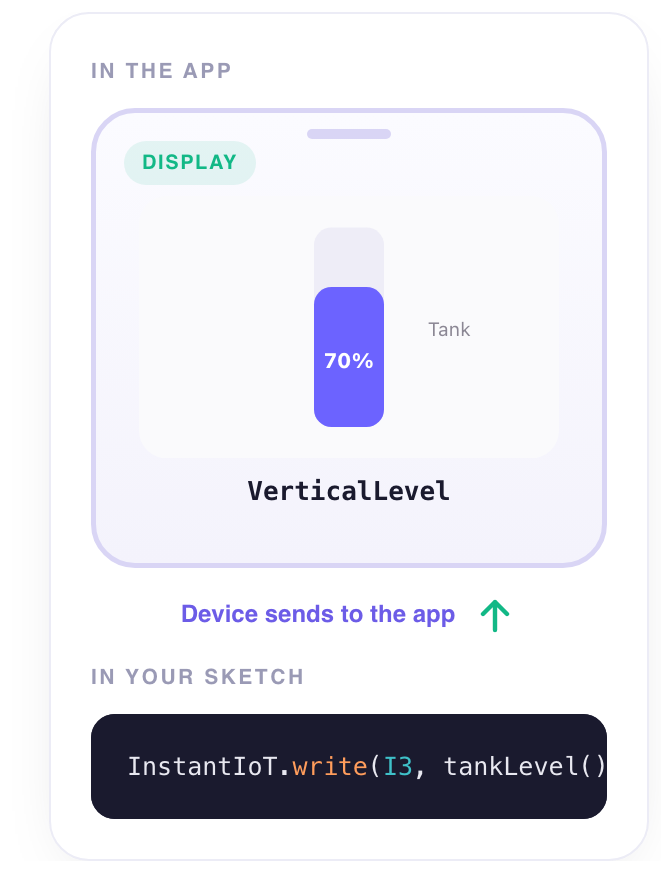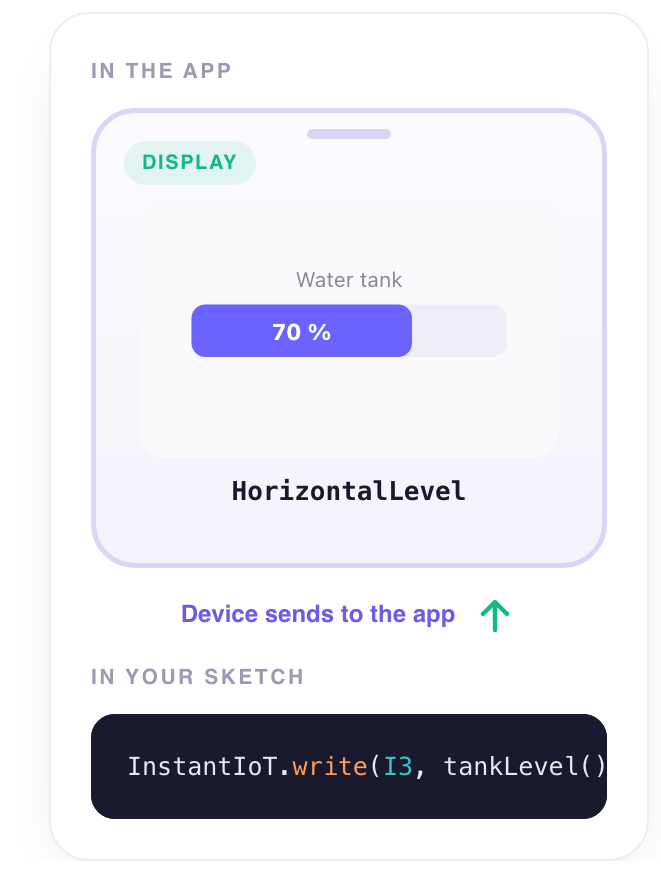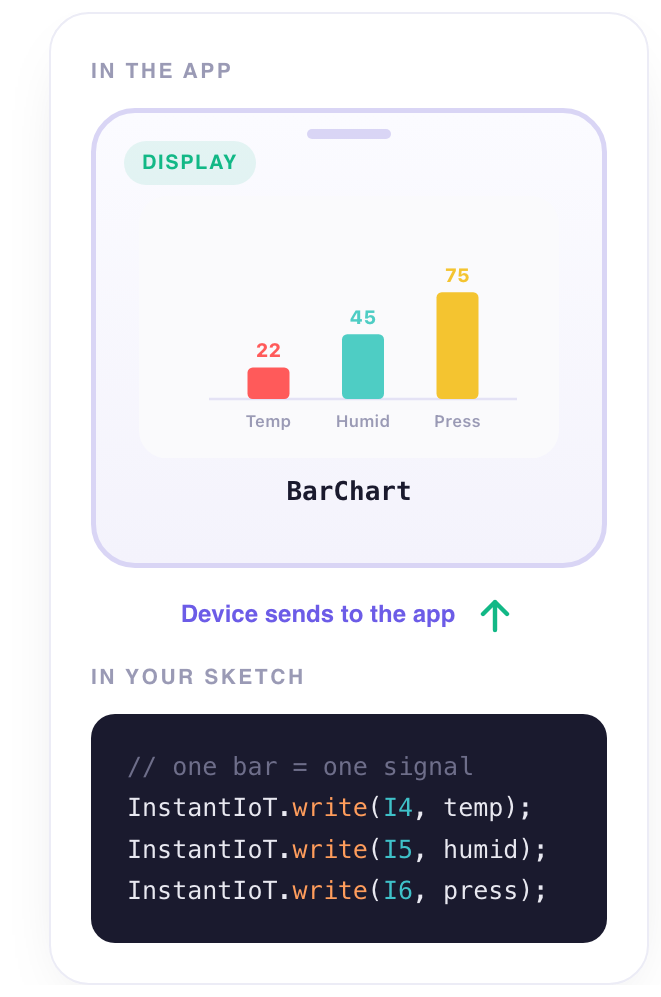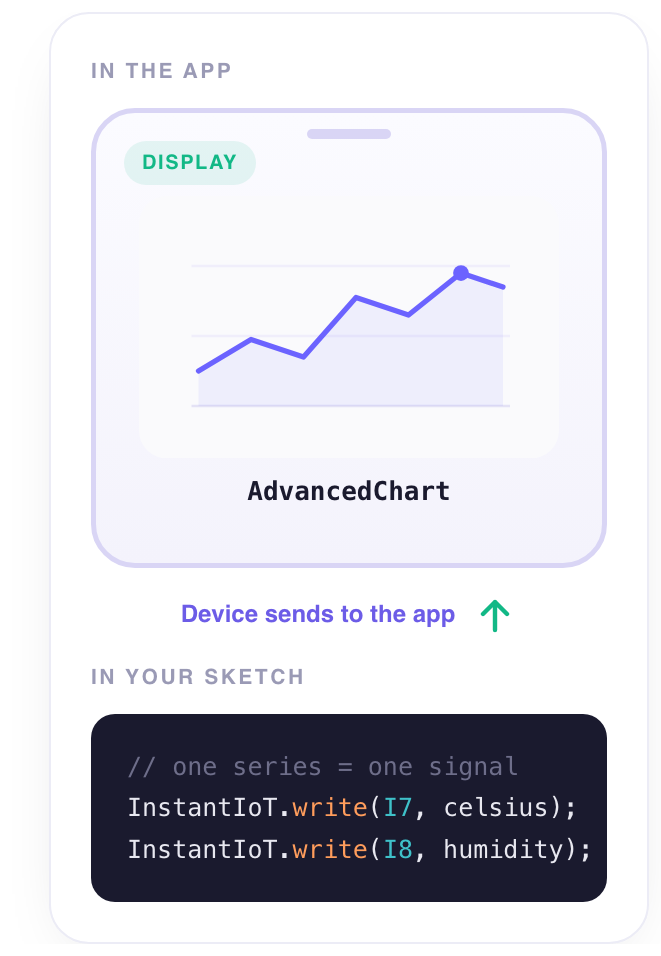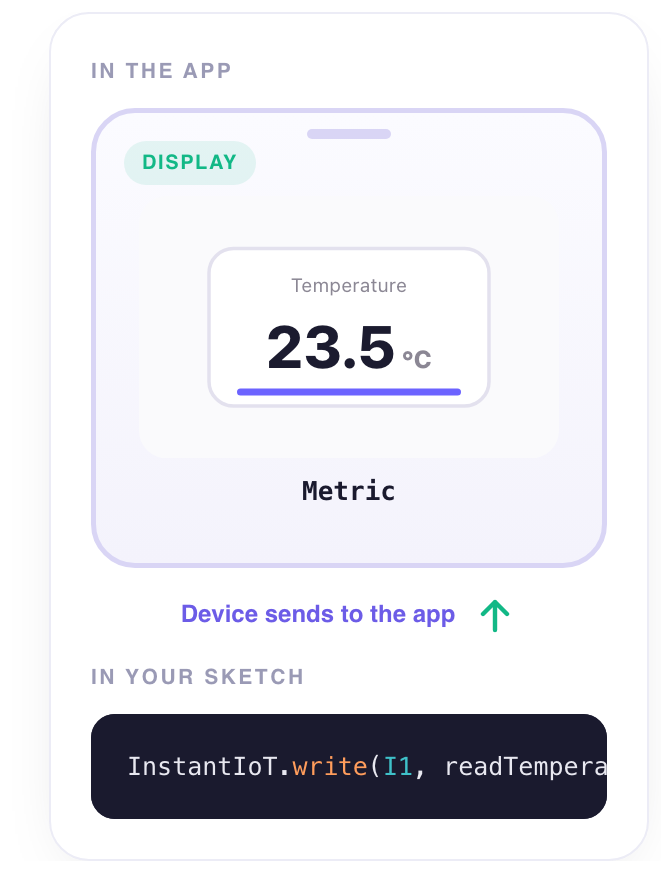
One number, big, with its name and its unit. The value you want to read from across the room — the temperature, the pressure, the count.
What it does
It shows the latest value of its signal, as the device writes it, with the unit and the decimals you gave the signal. Nothing to compute, nothing to scale: it prints what arrives.
When to use it
- The headline number — the one value a dashboard is about.
- A counter — cycles, litres, visitors.
- Several readings side by side — three metrics in a row are a control panel.
Set it up
- Declare the signal — Tap the device icon at the top right, then Declare a signal: give it a name, a type and a unit, and fill in the Format — minimum, maximum, decimals — because that is what the widget will use to scale and print the value.
- Place it — Back on the dashboard, in edit mode, tap + at the bottom and choose Metric under Displays. Four columns square is a good size.
- Wire it to the signal — Tap the widget: its settings open. In the Data tab, tap Pick a signal and choose the signal you declared.
- Write from the device — In the sketch, write the value to the signal’s address —
InstantIoT.write(I1, value)— and it shows up in the widget within a second.
Settings
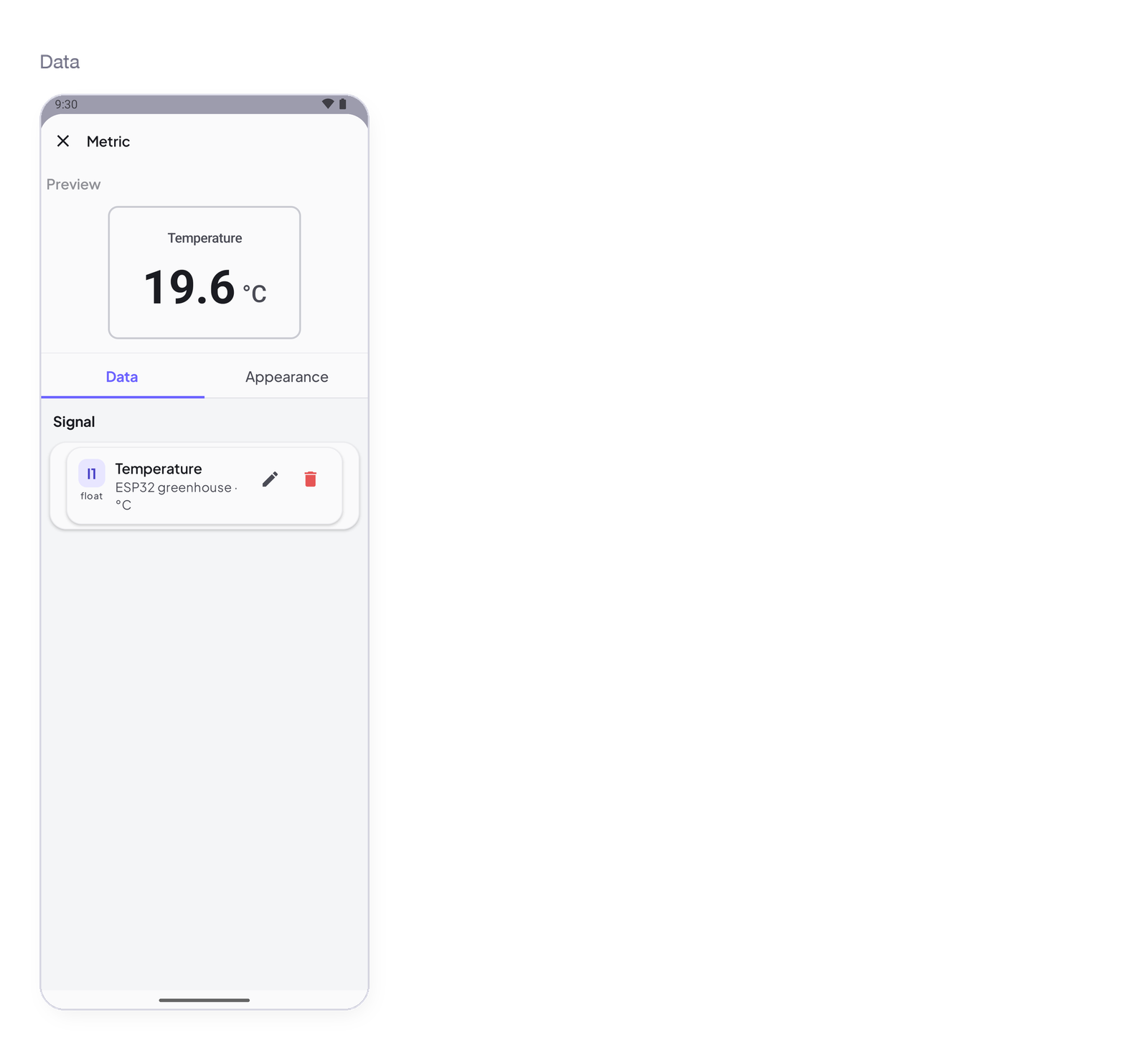
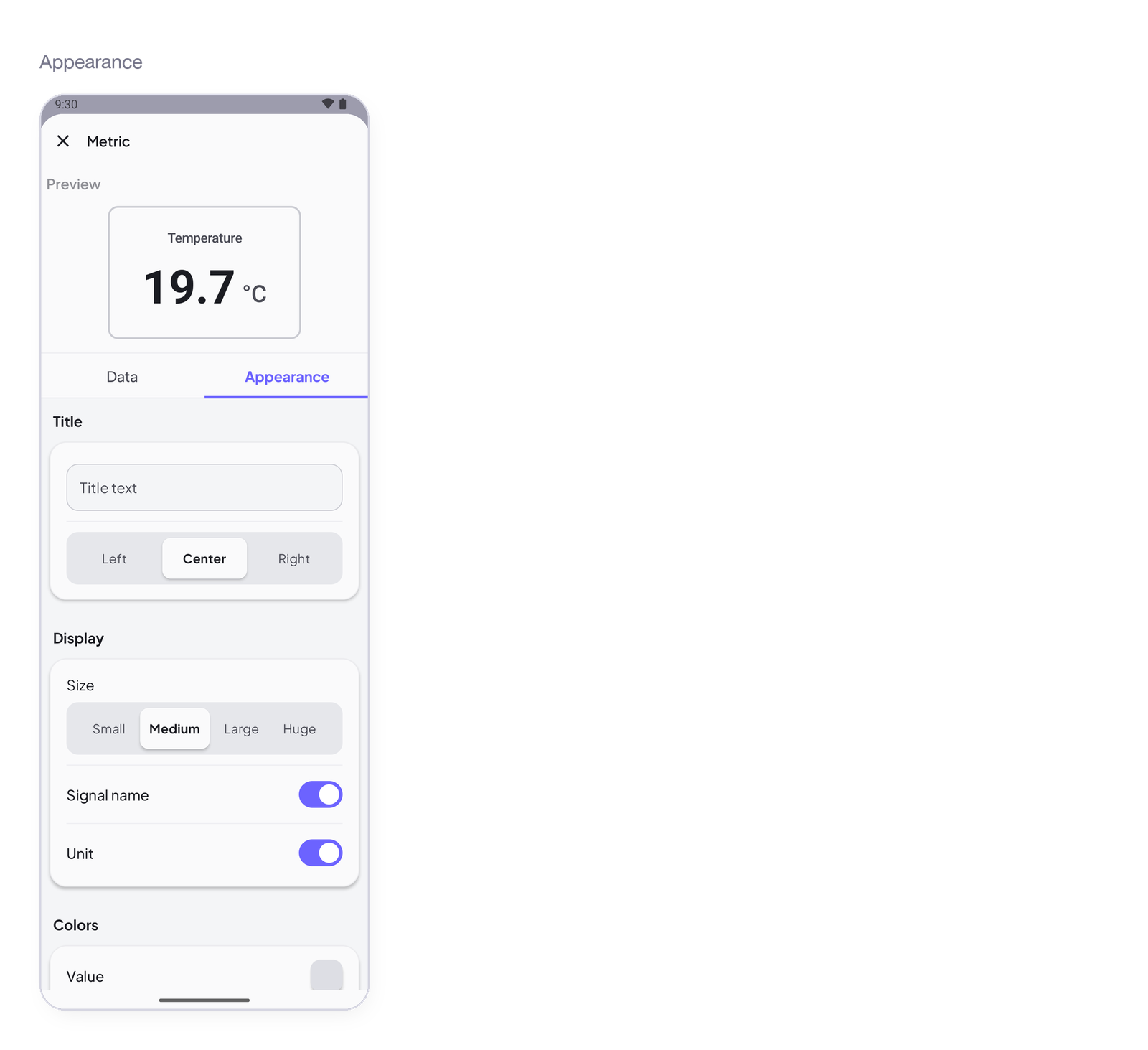
Tap the widget in edit mode: the sheet opens with a live preview at the top, then two tabs — Data for what it reads or writes, Appearance for how it looks.
Data — what it reads
Signal
| Setting | Type | Default | What it controls |
|---|---|---|---|
| Signal | one signal | empty — Pick a signal | The signal it reads. The unit and the decimals come from the signal’s format. Accepts an Integer or Decimal signal. The picker lists nothing else. |
Appearance — how it looks
Title
| Setting | Type | Default | What it controls |
|---|---|---|---|
| Title text | text | empty | A title above the widget. Empty means no title. |
| Alignment | Left / Center / Right | Center | Where the title sits. |
Display
| Setting | Type | Default | What it controls |
|---|---|---|---|
| Size | Small / Medium / Large / Huge | Medium | The size of the number. Huge is readable from two metres. |
| Signal name | toggle | on | Print the signal’s name above the number. |
| Unit | toggle | on | Print the unit after the number. |
Colors
| Setting | Type | Default | What it controls |
|---|---|---|---|
| Value | colour | theme | The number. |
| Background | colour | theme | The card. |
States
- Waiting for data — nothing has arrived yet on this signal; the widget shows a placeholder.
- Live — every value the device writes replaces the previous one.
- Device offline — the last value stays on screen; the device’s dot is grey in the device list.
Arduino device code
The address is all the device knows — I1 here; use the one the app gave your signal. In the sketch, one line, wherever you read the sensor:
InstantIoT.write(I1, readTemperature());
Complete sketch — Cloud
Paste it into the Arduino IDE, put your Wi-Fi and the token the app gave you, upload. It publishes once a second.
#include <InstantIoT.h>

const char* WIFI_SSID    = "MyWiFi";
const char* WIFI_PASS    = "MyPassword";
const char* DEVICE_TOKEN = "PASTE_TOKEN_HERE";

InstantTimer timers;

void publish() {
    InstantIoT.write(I1, readTemperature());   // a Decimal signal, unit °C, 1 decimal
}

void setup() {
    InstantIoT.begin(WiFiLink(WIFI_SSID, WIFI_PASS), Cloud(DEVICE_TOKEN));
    timers.every(1000, publish);
}

void loop() {
    InstantIoT.loop();
    timers.run();
}
Other connections
The widget block never changes. Only the begin() line says how the device reaches the app:
| Connection | begin() |
Devices |
|---|---|---|
| Cloud over Wi-Fi (above) | InstantIoT.begin(WiFiLink("MyWiFi", "secret"), Cloud(DEVICE_TOKEN)); |
ESP32 family, ESP8266, UNO R4 WiFi, MKR WiFi 1010, Nano 33 IoT, UNO WiFi Rev2 |
| Cloud over Ethernet | InstantIoT.begin(EthernetLink(), Cloud(DEVICE_TOKEN)); |
any board + an Ethernet shield |
| Direct — the device’s own Wi-Fi | InstantIoT.begin(AccessPoint("MyESP32", "12345678")); |
every board with Wi-Fi |
| Direct — Bluetooth LE | InstantIoT.begin(BLELink("MyESP32")); — #include <NimBLEDevice.h> first |
ESP32 family (not the S2) |
| Direct — Bluetooth Classic | InstantIoT.begin(BluetoothLink("MyESP32")); |
the original ESP32, Android only |
| Direct — a Bluetooth module (HC-05, HM-10) | InstantIoT.begin(SerialLink(Serial1)); — or SerialLink(13, 15) on ESP8266, SerialLink(10, 11) on UNO / Nano |
every board, radio or not |
| Your own InstantIoT Server (open source, at home) | InstantIoT.begin(WiFiLink("MyWiFi", "secret"), MyServer("192.168.1.42", DEVICE_TOKEN)); |
same as Cloud |
Direct needs no token: the phone is at the other end of the wire. See Connect for TLS, timeouts and what to do when it does not connect.
Any display works at the same address. A metric, a gauge and this widget on the same signal show the same value; the device does not change. Change the widget, not the sketch.
Notes
- A value that never changes usually means the sketch writes to another address than the one the signal has. Check
I1on both sides. - Once a second is plenty. The library paces itself, but your plan counts messages.
Next
→ Gauge — the same value on an arc → Advanced Chart — the same value over time